

About
The e-Dance project, was funded by the joint AHRC+EPSRC+JISC e-Science Initiative.
The project investigated how to capture and document the development of ideas and their materialization within practice-led dance research. The improvisational nature of dance posed challenges for analysis and reflection, as its generative and experiential qualities conflicted with traditional cognitive engagement methods. The research was based on a dialogue between dance and e-Science, leveraging advancements in visualizing and representing spatio-temporal structures and discourse.
Two main research questions guided the project. The first explored how the distributed Access Grid environment could provide new approaches to choreographic composition and how methodologies could be developed to capture and model practice-led research. The second examined how choreographic knowledge could shape e-Science applications to enhance usability within performance arts and the broader Arts and Humanities. The project studied interactivity in a distributed context, considered the implications of multi-perspective environments on choreographic authorship, and investigated how hypermedia and annotation tools could support the creative process.
Software deliverables were proposed to facilitate the dance research lifecycle, including enhancements for video features within the Access Grid, improved video annotation tools, and tools for planning dance pieces in virtual spaces. The project also aimed to develop an interface for storing large amounts of recorded material, improve the Access Grid’s video flexibility, and integrate better video streaming tools. Additionally, a choreographic planning tool was tested, incorporating spatial and temporal representations of performances.
Further developments included a portable video mapping studio for recording, annotating, and disseminating dance performances, an enhanced user interface for documenting the rehearsal and performance process, and tools to incorporate past performance records into new works. Efforts were also made to enable conversion of Access Grid media streams into widely used formats for dissemination. To address storage challenges, the project proposed integrating Memetic with a data Grid for scalable storage solutions.
Overall, the project sought to bridge dance and e-Science, using choreographic insights to refine digital tools while enhancing the documentation and analysis of practice-led research in performance arts.
The Software
For this project the Compendium mapping tool was extended to support both the design of the choreography for a dance piece and mapping over video content for analysis of rehearsals and performances.
A new Compendium map type was created for Movie maps.
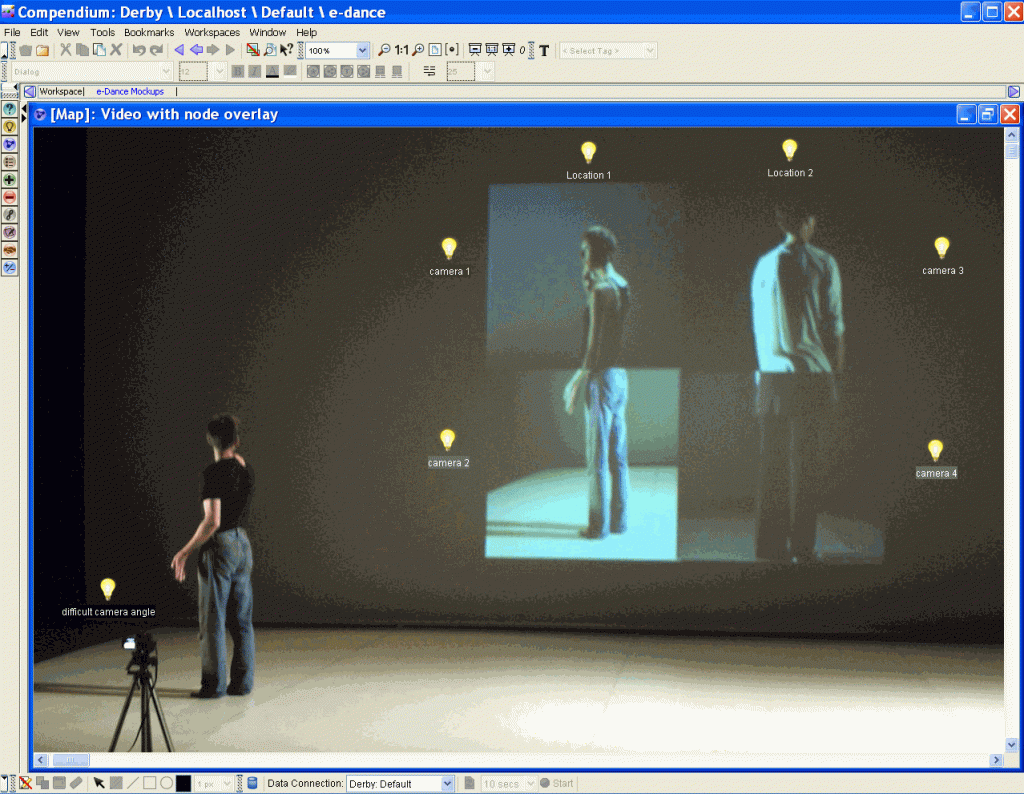
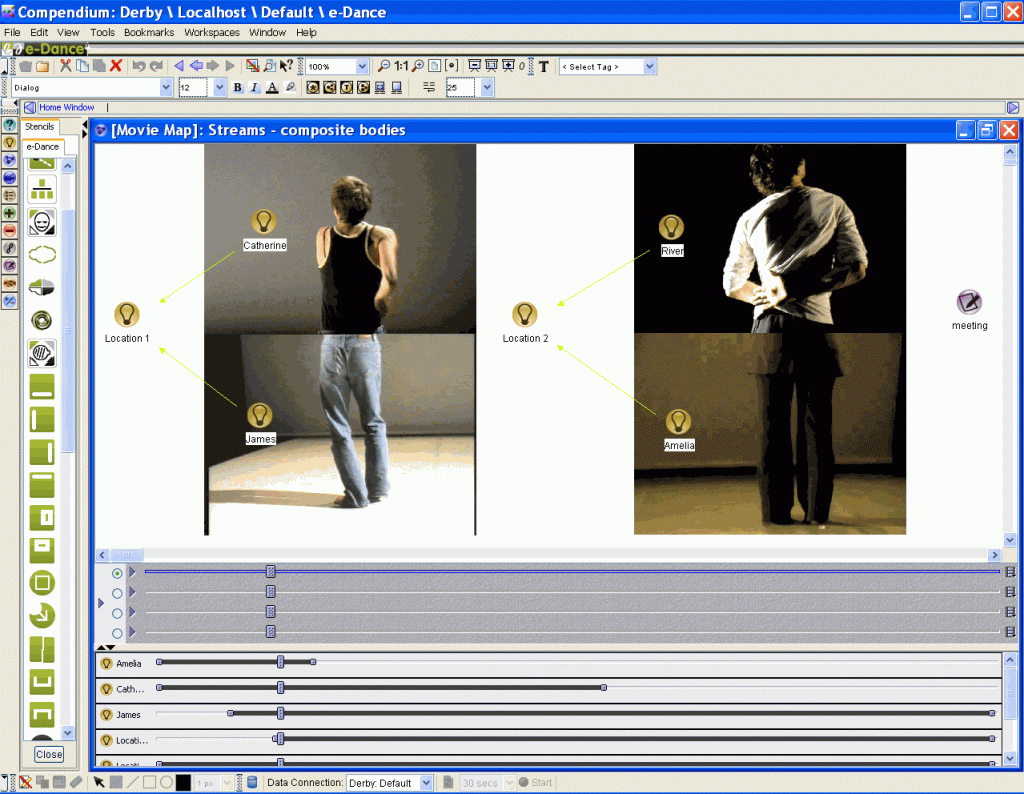
An interface was designed that could support mapping over multiple movies simultaneously across time. The movies could be positioned inside the map like any other map element. Above you can see an example of 4 movies in a movie map with discussion overlayed progressing through time.
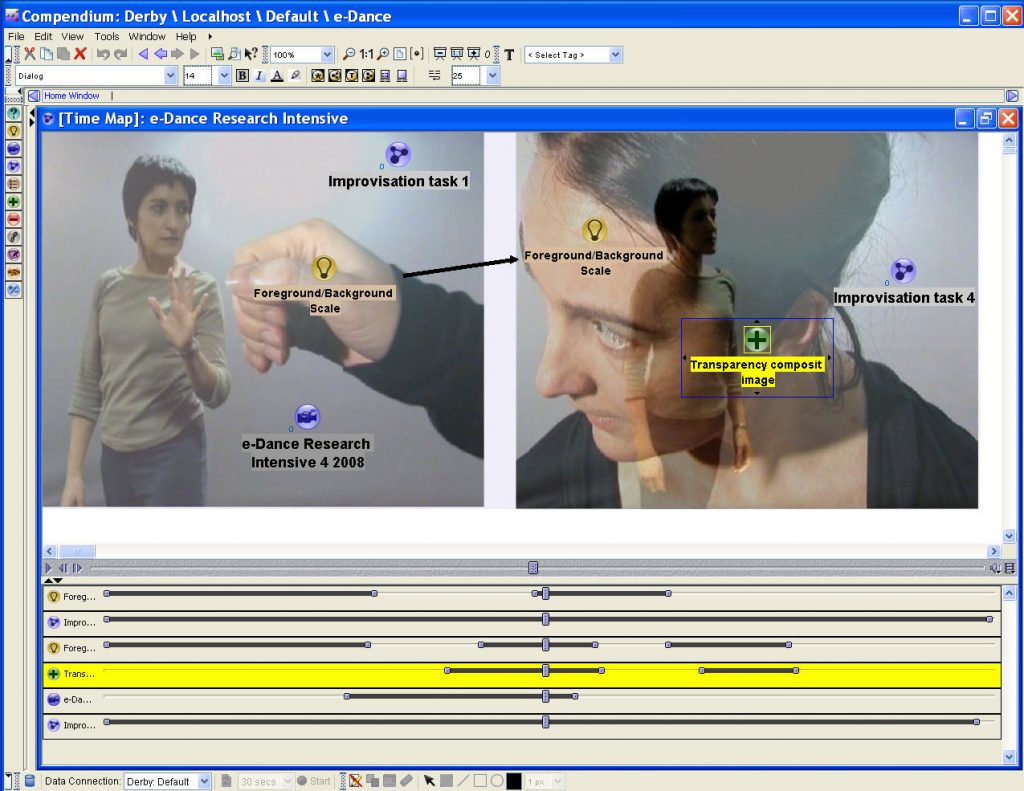
Mapped conversation elements would appear and disappear as the videos played inside a Compendium movie map, depending how they had been configured in the timeline dashboard. Above is an example with two movies being discussed and compared.
Once a movie map was setup, and discussion mapped over, it could be played. All movies in the map would play and the dialogue points would appear as scheduled in the timeline interface.
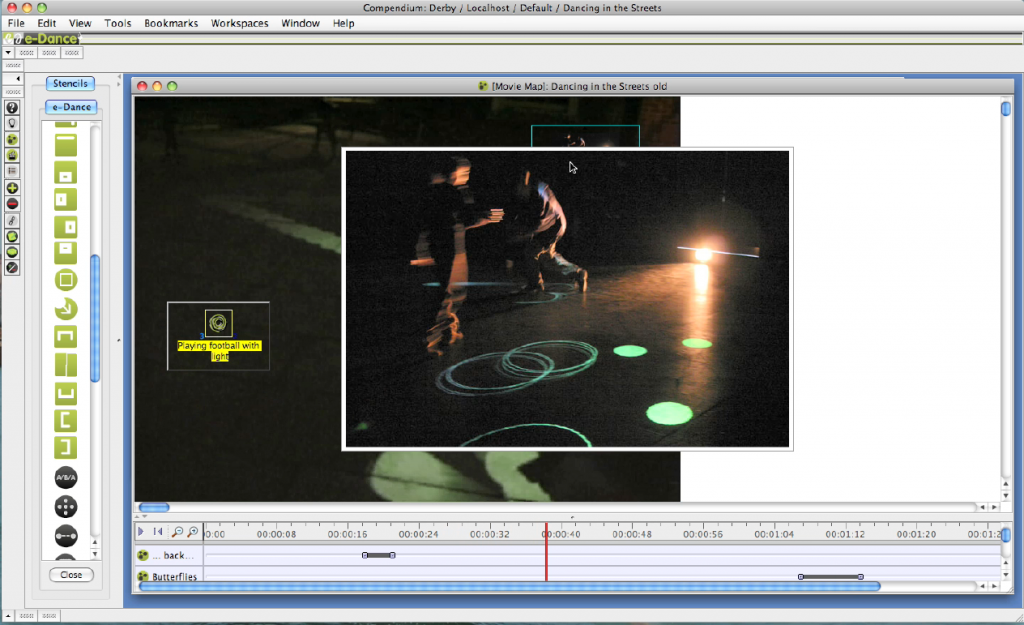
Compendium could be used to play multiple movie clips simultaneously, with or without mapping over the top.
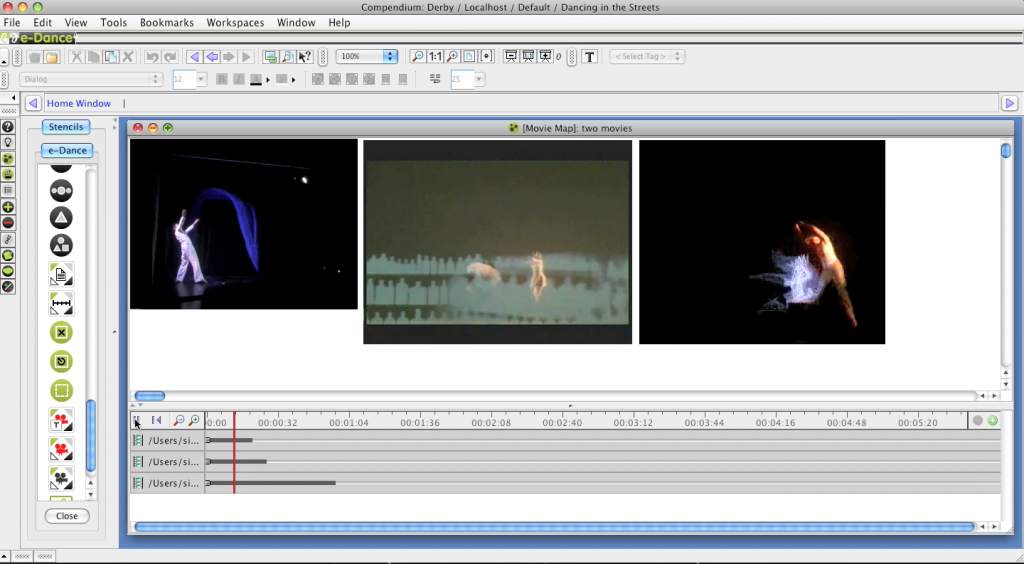
From a coding perspective, this was the most complex extension to the Compendium mapping platform undertaken over it’s research lifetime.
Team
Helen Bailey
Simon Buckingham Shum
Michael Daw
Sita Popat
Martin Turner
Michelle Bachler
Anja Le Blanc
Andrew Rowley
Publications
Bailey, H., Bachler, M., Buckingham Shum, S., Le Blanc, A., Popat, S., Rowley, A. and Turner, M. (In Press). Dancing on the Grid: Using e-Science Tools to Extend Choreographic Research. Phil. Trans. R. Soc. A (Crossing Boundaries: Computational Science, E-Science and Global E-Infrastructures). [PDF]
“e-Dance: Relocating Choreographic Process”, New Paradigms in Performance International Symposium, University of Salford, UK, November
“Relocating Choreographic Process: The Impact of Collaborative Memory and Grid technologies on Practice-led Research in Dance – A Preliminary Report” DRHA2007 (Digital Resources in the Huamities & Arts) Annual International Conference, Dartington College of Arts, UK, September
“e-Dancing: The Impact of VREs on Defining New Research Methodologies for Embodied Practice-led research in Choreography and Performance” UK e-Science All-Hands Meeting, Annual, International Conference, Nottingham University, UK, September


